 Balance Guard
Currency Pairs in Forex: Major, Minor, and Exotic Pairs Explained
In the Forex market, currencies are never traded in isolation. Every transaction involves the simultaneous buying of one currency and selling of another, forming what is known as a currency pair. This structure is not just a technical detail; it reflects the relative strength between two economies. Unlike equities, where value can be analyzed independently, Forex is inherently comparative. Understanding how currency pairs work is therefore the foundation of trading in the foreign exchange market.
The Forex market is the largest financial market in the world, with daily trading volume exceeding $9.6 trillion. This scale highlights the importance of currency flows in global capital allocation. Forex currency pairs are typically divided into three main categories:
In this guide, you will learn how Forex pairs work, the most traded currency pairs in the market, and how traders choose which pairs to trade.
What Are Currency Pairs?
A currency pair represents the exchange rate between two currencies, indicating how much of one currency is needed to purchase another. Each pair consists of a base currency and a quote currency. The base currency is the first currency in the pair, while the quote currency is the second.
For example:
EUR/USD = 1.10
This means one euro is worth 1.10 US dollars.
| Component | Meaning |
|---|---|
| Base currency | The first currency in the pair |
| Quote currency | The second currency in the pair |
| Exchange rate | Price of base currency in quote currency |
At a deeper level, this price reflects the market’s consensus on the relative strength of the Eurozone economy compared to the United States. Exchange rates are determined by supply and demand dynamics, influenced by trade flows, capital movements, and macroeconomic expectations. If the price rises, it indicates that the base currency is strengthening relative to the quote currency. If it declines, the opposite is true.
How Forex Currency Pairs Work
Every movement in a currency pair reflects the interaction between two economies. When a trader buys a pair, they are positioning for the base currency to outperform the quote currency; when they sell, they expect the opposite. This makes Forex inherently macro-driven, as participants constantly assess economic conditions, monetary policy, and capital flows across countries.
For example, if the Federal Reserve tightens policy while the European Central Bank remains accommodative, the interest rate differential widens. This encourages capital to flow into dollar-denominated assets, strengthening the US dollar, and pushing EUR/USD lower. Importantly, currency markets are forward-looking. Prices tend to move based on expectations of future policy rather than current conditions, which is why central bank communication and economic forecasts play a critical role in price action.
Types of Currency Pairs
Forex pairs are grouped into three main categories based on liquidity and trading volume. Forex pairs are classified across three key categories:
- Major pairs: The most traded and recognized Forex pairs, with the USD featured on one side of the pair. Example: EUR/USD, USD/JPY
- Minor pairs: FX pairs featuring currencies from major non-US economies. Example: EUR/GBP, AUD/JPY
- Exotic pairs: Pairs featuring one major currency and a currency of a smaller or emerging economy. Example: USD/TRY, EUR/HUF
What are Major Currency Pairs, or "Majors"?
Major pairs are the most actively traded currency pairs in the Forex market and always include the US dollar. They are typically defined by their high liquidity and global trading volume, rather than by a fixed list. The majors include EUR/USD, USD/JPY, GBP/USD, USD/CHF, USD/CAD, AUD/USD, and, in many classifications, NZD/USD. Because of their high liquidity, major pairs offer tighter spreads, lower transaction costs, and more efficient execution. They also tend to react quickly to economic data releases and central bank decisions, making them particularly attractive for both short-term traders and macro-focused investors. For beginners, majors provide a more stable and accessible trading environment. For professional traders, they offer the depth and consistency required to execute larger positions efficiently.
| Forex pair | Currencies involved |
|---|---|
| EUR/USD | Euro vs. US Dollar |
| USD/JPY | US Dollar vs. Japanese Yen |
| GBP/USD | Great British Pound vs. US Dollar |
| USD/CHF | US Dollar vs. Swiss Franc |
| USD/CAD | US Dollar vs. Canadian Dollar |
| AUD/USD | Australian Dollar vs. US Dollar |
| NZD/USD | New Zealand Dollar vs. US Dollar |
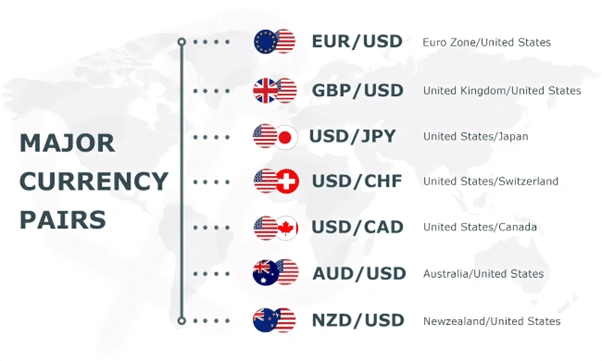
EUR/USD (Euro vs. US Dollar)
EUR/USD signifies the number of US Dollars needed to purchase one Euro. It is seen as the most important Forex pair as USD and EUR are the two most-traded currencies globally - USD featured in 88% of all Forex trades and EUR on 31% as of April last year. They are also the first and second-largest reserve currencies in the world. The US Federal Reserve controls the supply of USD, whereas the supply of EUR is controlled both by the European Central Bank (ECB) and the central banks of the eurozone countries. Although the US Dollar has been forecast to eventually surrender its dominant global position to the Euro, the US currency still remains safe in times of crisis and is the key global reserve currency.
USD/JPY (US Dollar vs. Japanese Yen)
The Japanese Yen (JPY) is the third most traded currency globally and a popular reserve currency. The population of Japan is around 40% that of the US, and its economy is also relatively large. The Bank of Japan controls the supply of the Yen. The Yen is seen as an ultimate safe haven currency (even more so than the US Dollar) in times of global stress. This is because of various factors, including the super low interest rates in Japan since the 1990s, repatriation pressures from its positive net foreign asset position and historical, traditional reasons.
GBP/USD (Great British Pound vs. US Dollar)
The British Pound (GBP) is the oldest currency globally that is still in circulation. It is also the third most popular reserve currency (after the US Dollar and Euro) and the fourth most traded currency. GBP/USD is commonly known as Cable in the Forex world, a relic of the 19th century when the exchange rate was transmitted across the Atlantic by a submarine cable. Even before the UK exited the European Union with Brexit in 2020, it was one of the few countries that had elected not to adopt the EUR, keeping GBP as its national currency instead.
USD/CHF (US Dollar vs. Swiss Franc)
The Swiss Franc is known in the currency trading world as the "Swissie," while its currency code, CHF, comes from the old Latin name for Switzerland, Confederation Helvetica, with the F standing for Franc. Switzerland is one of Europe's most productive and stable economies, and the Swiss Franc is backed up by large gold reserves. The Swiss have resisted converting to the Euro or even joining the EU. The stability of the Swiss Franc is one of the reasons, alongside its traditional neutral positive with respect to global conflicts, that makes it another safe-haven currency.
USD/CAD (US Dollar vs. Canadian Dollar)
The Canadian Dollar, or CAD, is often called the "Loonie" in the world of Forex trading because of the Canadian one-dollar coin featuring an image of a common bird in Canada, the loon. The Canadian Dollar is closely correlated with the US Dollar because of their close economic ties as neighbouring countries. The US is Canada's largest trading partner, with total trade between the two countries crossing $960 billion in 2022 (63.4% of worldwide trade). Some of Canada's exports include timber, with oil prices being one of the main factors influencing the CAD's value. For this reason, the Canadian Dollar sits in a basket of currencies that are referred to as commodity currencies.
AUD/USD (Australian Dollar vs. US Dollar)
The Australian Dollar, or AUD, was introduced in 1966 to replace the Australian Pound and is the currency of the Australian Commonwealth (which includes Australia, seven dependent territories and three countries). Today, the Australian Dollar (AUD) is one of the most traded currencies globally (fifth behind USD, EUR, JPY, and GBP). The Australian economy is a large producer and exporter of raw materials, including iron ore, coal, petroleum gas, gold, and aluminium oxide. For this reason, and like the Canadian Dollar, the Australian Dollar is referred to as a commodity currency.
NZD/USD (New Zealand Dollar vs. US Dollar)
The New Zealand Dollar (NZD) is commonly known as the "Kiwi" in the Forex market, a reference to New Zealand’s national bird. Despite the relatively small size of its economy, the NZD is among the most actively traded currencies globally due to its liquidity and accessibility. New Zealand’s economy is heavily reliant on exports, particularly in the agricultural sector, including dairy products, meat, and wool. As a result, the NZD is often influenced by global commodity prices and demand from key trading partners such as China. Like the Australian and Canadian Dollars, the NZD is considered a commodity currency. Its value tends to be sensitive to global growth expectations and risk sentiment, often strengthening during risk-on environments and weakening during periods of market uncertainty.
What Are Minors Currency Pairs?
Minor currency pairs, also known as cross-currency pairs or simply “crosses,” are currency pairs that do not include the US dollar. Instead, they represent exchange rates between other major global currencies.
Examples include:
- EUR/GBP: Euro/British Pound
- EUR/JPY: Euro/Japanese Yen
- GBP/JPY: British Pound/Japanese Yen
- AUD/JPY: Australian Dollar/Japanese Yen
- EUR/AUD: Euro/Australian Dollar
- CAD/JPY: Canadian Dollar/Japanese Yen
In the Forex market, the term “cross” broadly refers to any pair without the USD, while “minor pairs” typically describe crosses composed of major global currencies such as the euro, pound, yen, and Swiss franc.
Key Characteristics of Minor Pairs
Compared to major pairs, minors tend to have:
- Slightly lower liquidity
- Wider spreads
- Stronger movements driven by regional economic factors
Despite lower volume than USD-based pairs, minor pairs remain highly liquid and are actively traded by both institutional and retail participants. Under normal market conditions, they still provide efficient execution. One of their most important characteristics is their sensitivity to regional economic dynamics. While major pairs are heavily influenced by US macroeconomic conditions, minor pairs reflect the relative performance between two non-US economies. This often leads to clearer directional trends when there is divergence in:
- Interest rates
- Economic growth
- Inflation
- Central bank policy
For example, a widening interest rate differential between the Eurozone and the United Kingdom can create sustained trends in EUR/GBP. Similarly, Japanese Yen crosses (such as GBP/JPY or EUR/JPY) are often driven by global risk sentiment and monetary policy from the Bank of Japan.
What Are Currency Crosses?
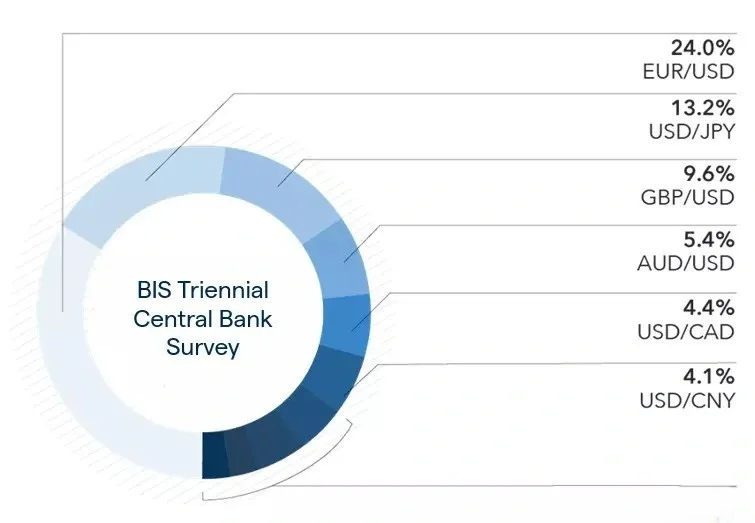
Currency crosses refer to transactions between two currencies where the US dollar is not used as an intermediary. In modern Forex markets, most crosses are quoted directly, but historically they were derived through USD-based pairs. Today, commonly traded crosses include pairs such as EUR/GBP, EUR/JPY, GBP/JPY, and EUR/CHF. While some of these rank among the most traded pairs globally, the majority of overall Forex volume still involves USD-based pairs, reinforcing the dominance of the US dollar in global markets, according to data from the Bank for International Settlements (BIS) Triennial Central Bank Survey.
Most Commonly Used Currency Crosses
Some of the most used currency crosses are, of course, the most traded and most abundant currencies, with common examples being the EUR/GBP, GBP/JPY, EUR/JPY and EUR/CHF. Only the former two are in the world's ten most traded currency pairs, all the rest involving the USD, showing it has maintained dominance in financial markets.
How Currency Crosses are Calculated
Currency crosses are now generally established as their own exchange rate, but if we did not have this rate, we could calculate it fairly accurately with the method below. When calculating what a currency cross should be valued at, we must first establish which currency is going to be our base rate, so set to equal one. For all currency crosses in which the Euro is involved, it becomes the base rate, if the GBP is involved and the Euro is not, GBP is instead established as the base rate. Once the currency we will use for the base rate is set, you must then find each currency's exchange rate against the USD, with these rates being referred to as the legs of our currency cross. We must make sure we are using the bid (buying price) or ask (selling price) for both exchange rates, and for simplicity, we can make sure our first currency (GBP) is the base rate in its exchange vs the USD and in the second exchange the USD is the base rate. If this is the case, we simply multiply the bid/ask price of the two legs and get the price of the currency cross.
Example: Calculate GBP/JPY
GBP/USD: 1.15 (bid)
USD/JPY: 144.21 (bid)
GBP/JPY: 1.15 * 144.21 = 165.84 (bid)
Advantages of Currency Crosses
As we have seen, currency crosses have become more prevalent as the Forex market and trade have expanded into the end of the 20th Century. These direct exchanges provide multiple advantages for individuals, companies, and traders, which we will now look into. Naturally, currency crosses make it easier to make international transactions as there are fewer steps to go through and fewer currencies to deal with, with this also making the transaction cheaper as it then involves only crossing one spread. This benefit is furthered by the fact currency crosses have become much more frequently used for exchanges, meaning the spreads have narrowed, especially for the major currency crosses. This has occurred due to the demand for the currency cross increasing, decreasing the cost of international transactions further. This decreased cost can be seen clearly in our basic calculation above, where we established the GBP/JPY cross was 165.84 when calculating through the USD, but the actual GBP/JPY at the time of writing is 165.34. This seemingly small gap can make a huge difference when large sums are being converted.
How Traders Can Use Currency Crosses
Currency crosses can be used in multiple ways by traders in order to try and gain an edge and make profits. One-way traders may use a currency cross is to bet on world events, with an easy example being Brexit. The trader could set up a position in either direction by using the EUR/GBP, this would be less capital intensive, less complex and less expensive than using both the EUR/USD/ and GBP/USD to set up your position. Furthermore, the trader may want to use a currency cross in order to take up a position on a certain currency while removing the presence of the USD if they think it may also be impacted. Another reason for traders to use currency crosses as it gives them more options in how and what they trade. This can be seen by looking at the majors and the commodity currencies, all of which involve an exchange that involves the USD. Trading just these, which many traders do, not only restricts them to only seven exchanges to trade but also means a vast majority of their trade speculation depends on if the dollar is weak or strong on the day. Trading cross currencies eliminates this anti/pro USD restriction and opens up a vast array of other less popular currencies to trade.
What Are Exotic Currency Pairs?
Exotic currency pairs consist of one major currency paired with the currency of an emerging or less-developed economy. Unlike major and minor pairs, they are less frequently traded and tend to have lower overall market liquidity.
Examples of Exotic Currency Pairs
These pairs reflect economic conditions in smaller or emerging markets, making them highly sensitive to local developments. Unlike major currencies, which are driven primarily by global macroeconomic trends, exotic currencies are often influenced by country-specific factors such as political stability, inflation volatility, central bank credibility, and external debt levels.
| Exotic Pair | Meaning |
|---|---|
| USD/TRY | US Dollar/Turkish Lira |
| EUR/TRY | Euro/Turkish Lira |
| USD/ZAR | US Dollar/South African Rand |
| USD/MXN | US Dollar/Mexican Peso |
| USD/THB | US Dollar/Thai Baht |
As a result, price movements in these pairs can be more reactive to unexpected news, policy changes, or shifts in investor sentiment toward emerging markets. This sensitivity can create sharp and sometimes unpredictable movements, particularly during periods of economic uncertainty or global risk aversion.
Key Characteristics of Exotic Pairs
Compared to major and minor pairs, exotic pairs typically exhibit:
- Lower liquidity
- Wider spreads
- Higher volatility
- Less consistent price behavior
Because of reduced market participation, price movements in exotic pairs can be more abrupt and less predictable. Even relatively small orders can have a noticeable impact on price. At the same time, this lower liquidity is what often creates larger price swings, making exotic pairs attractive to traders seeking higher return potential.
What Drives Exotic Currency Pairs?
Exotic pairs are heavily influenced by a combination of macroeconomic and country-specific factors. Key drivers include:
- Political stability and government policy
- Inflation and interest rates
- Commodity dependence
- Foreign investment flows
- Geopolitical risk and external shocks
Unlike major pairs, where price action is largely driven by global macro trends, exotic pairs often react more strongly to localized events. Unexpected policy changes or political developments can trigger sharp and sudden movements.
Advantages of Trading Exotic Pairs
Exotic pairs can offer unique opportunities for traders willing to manage the additional risks involved.
- Unique market opportunities: Exotic currencies often react to local events that are not priced into major pairs, creating distinct trading setups.
- High return potential: Increased volatility can lead to larger price movements, allowing traders to capture significant gains when positioned correctly.
- Portfolio diversification: Exotic pairs provide exposure to different economies, helping traders diversify beyond USD-driven or developed market trades.
Disadvantages of Trading Exotic Pairs
Despite their potential, exotic pairs come with important challenges.
- Higher transaction costs: Lower liquidity leads to wider spreads, increasing the cost of entering and exiting trades.
- Increased risk and volatility: Price swings can be aggressive and less predictable, exposing traders to larger losses if risk is not properly managed.
- Limited information and analysis: Compared to major currencies, reliable data and market coverage can be more limited, making analysis more difficult.
How Traders Use Exotic Pairs
Exotic pairs are typically used by traders looking to expand beyond traditional markets and capture opportunities driven by specific economic or geopolitical themes. They are often used to:
- Trade country-specific developments
- Gain exposure to emerging markets
- Diversify trading strategies
- Capture volatility-driven opportunities
However, due to their complexity, they are generally more suitable for traders who already have experience with major and minor pairs.
Trading Forex Currency Pairs
Forex traders can choose from a wide range of currency pairs, each offering different characteristics and opportunities. While some traders prefer highly liquid and stable markets, others seek stronger volatility or more region-specific trends. These differences come from the type of currency pair being traded. Major, minor, and exotic pairs each behave differently in terms of liquidity, volatility, and the factors that drive price movements. Because of this, traders must align their approach with the characteristics of each pair. However, regardless of the category, the overall trading process remains structured and consistent:
- Understand How Different Currency Pairs Behave. Develop a deep understanding of how different types of pairs behave. Major pairs tend to be driven by global macroeconomic factors such as interest rates, inflation, and central bank policy. Minor pairs are more influenced by regional economic divergence, often reflecting relative strength between developed economies without direct USD exposure. Exotic pairs require additional caution, as they are often impacted by political instability, lower liquidity, and external shocks.
- Choose the Right Pair for Your Trading Style. Different pairs serve different trading styles. Major pairs are typically preferred for lower spreads, smoother execution, and macro-driven strategies. Minor pairs can offer cleaner trends when there is a clear divergence between two economies. Exotic pairs may provide larger price movements, but they also come with higher costs and increased unpredictability.
- Validate Your Strategy in a Demo Environment. Before risking real capital, validate your strategy in a demo account. This helps refine execution, improve timing, and identify weaknesses without financial pressure. It also builds discipline and confidence, allowing traders to test their approach and understand performance before moving to live markets.
- Transition to live trading with discipline. Once consistency is achieved, move to a live trading account with a structured plan. Apply strict risk management rules, including stop-loss placement and risk-reward ratios. Execution becomes even more critical when trading less liquid pairs, where spreads and slippage can have a larger impact.
- Adapt to liquidity and volatility conditions. Not all currency pairs behave the same way under different market conditions. Major pairs tend to remain liquid even during volatile periods, while minors and exotics can experience sharp price gaps or reduced liquidity. Understanding these differences allows traders to adjust position size, stop placement, and expectations accordingly.
- Monitor macroeconomic and global factors. Forex markets are fundamentally driven by macroeconomics. Interest rate differentials, central bank communication, inflation trends, and geopolitical developments all influence currency movements. For major pairs, global themes dominate. For minors, regional dynamics become more relevant. For exotics, country-specific risks can be the primary driver.
- Prioritize risk management above all. Regardless of the pair being traded, risk management remains the most important factor. Higher volatility in exotic pairs requires smaller position sizes, while even major pairs can become unpredictable during major economic releases. Experienced traders focus on capital preservation through consistent risk-reward frameworks, disciplined execution, and controlled exposure.
6 Most Traded Forex Currency Pairs in 2026
In 2026, the "Majors" continue to dominate global trading volume, accounting for approximately 85% of all Forex transactions. The US Dollar remains the world’s primary reserve currency, appearing in nearly 90% of all trades.
1. EUR/USD (The Fiber)
Market Share: 24% daily volume.
2026 Outlook: Remains the most traded pair globally. In early 2026, it is marked by a "bullish consolidation" as traders weigh the ECB’s forward guidance against the Fed’s interest rate path. It offers the tightest spreads and highest liquidity.
2. USD/JPY (The Gopher)
Market Share: 13% of daily volume.
2026 Outlook: A critical pair for 2026 due to its sensitivity to global risk sentiment. With ongoing tensions in the Middle East and energy price fluctuations, the Yen is frequently used as a safe-haven hedge. It is also a favorite for "carry trades" depending on US-Japan yield differentials.
3. GBP/USD (Cable)
Market Share: 9.6% of daily volume.
2026 Outlook: Currently trading around the 1.33–1.34 range. It remains highly reactive to UK employment data and global risk appetite. It is popular among swing traders for its clear intraday trends.
4. AUD/USD (The Aussie)
Market Share: 5.4% of daily volume.
2026 Outlook: As a "commodity currency," the Aussie is the go-to pair for traders seeking exposure to iron ore, gold, and the broader Asia-Pacific economic cycle. It has shown a strong recovery in 2026 following shifts in the Reserve Bank of Australia’s (RBA) policy.
5. USD/CAD (The Loonie)
Market Share: 4.4% of daily volume.
2026 Outlook: Closely tied to the price of crude oil. In 2026, volatility in this pair has increased due to disruptions in energy supply chains, making it a staple for North American session traders.
6. USD/CNY (The Dragon)
Market Share: 4.1% of daily volume.
2026 Outlook: Currently trading in the 6.89–6.92 range. Unlike the free-floating majors, this pair is defined by the PBOC’s daily fixing and capital controls. In 2026, it serves as a primary indicator of US-China trade tensions and China's internal stimulus measures. It is a vital pair for macro traders tracking the global manufacturing cycle and the shifting landscape of "de-dollarization" in international reserves.
Key Drivers for 2026:
- Geopolitical Risk: Middle East conflicts are reviving demand for safe havens like the USD, JPY, and Gold.
- Monetary Policy Divergence: The primary theme is the timing of interest rate cuts by the Fed versus other major central banks.
- Commodity Influence: High demand for industrial metals and oil continues to drive volume in AUD, CAD, and NZD pairs.
What Makes a Currency Strong or Weak in Forex
Currency strength is not just a random ranking but a reflection of a nation's economic resilience and stability. So, what exactly makes a currency strong? Let's uncover the key factors that contribute to a currency's financial muscle:
- Economic Stability: A strong currency relies on a stable and thriving economy as its foundation. Signs of economic stability include low inflation rates, consistent economic expansion, and a robust job market.
- Foreign Exchange Reserves: The quantity of foreign currency stored in a nation's central bank reserve is of vital importance. A substantial reserve helps maintain exchange rate stability and boosts confidence in the currency.
- Low National Debt: A nation with a manageable national debt burden is more likely to have a strong currency. High levels of debt can lead to inflation and currency depreciation.
- Political Stability: A stable government and political environment are essential. Political turmoil and uncertainty can negatively impact a currency's strength.
- Trade Balance: A positive trade balance, where a country exports more than it imports, can contribute to a strong currency. It reflects a nation's economic competitiveness.
- Monetary Policy: The policies set by a central bank, including interest rates and money supply control, influence a currency's strength. Responsible monetary policies are vital.
- Global Confidence: A currency's reputation on the global stage matters. Currencies that are widely accepted and trusted in international trade and finance tend to be stronger.
- Natural Resources: Nations with abundant natural resources often have strong currencies, as these resources support economic growth and exports.
- Fiscal Policies: Responsible government fiscal policies, including taxation and public spending, can impact a currency's strength.
Understanding these factors helps you grasp why certain currencies emerge as the frontrunners. It's not just about the exchange rate; it's about the robust economic foundations beneath.
How Traders Choose Currency Pairs
Selecting a currency pair involves evaluating several critical factors to align with your specific trading goals:
- Liquidity and Spreads: Traders often gravitate toward major pairs like EUR/USD or USD/JPY because they offer the highest liquidity. High liquidity typically results in tighter bid-ask spreads, which reduces transaction costs—a vital consideration for high-frequency or day traders.
- Volatility Levels: Your choice may depend on whether you seek stable trends or high-action price swings. While major pairs are relatively stable, exotic pairs (such as USD/TRY or USD/ZAR) offer significantly higher volatility. This volatility presents opportunities for substantial returns but carries a magnified risk of loss.
- Fundamental Drivers: Traders often select pairs based on their knowledge of specific economic drivers. For instance, those who follow energy markets may trade commodity currencies like USD/CAD, which is closely correlated with oil prices. Others may focus on "safe-haven" currencies like the Japanese Yen (JPY) or Swiss Franc (CHF) during periods of global geopolitical stress.
- Market Hours and Activity: Since trading activity varies by session, traders often choose pairs that are most active during their preferred trading hours. For example, pairs involving the Australian Dollar (AUD) or Japanese Yen (JPY) see increased volume during the Asian session.
- Risk Management and Diversification: Including a mix of majors, minors (crosses), and exotics can be a strategy for portfolio diversification. Diversification helps manage risk, especially when major pairs show stagnant price movements.
Ultimately, successful traders use a combination of technical analysis (chart patterns and indicators) and fundamental analysis (economic indicators and central bank decisions) to shortlist pairs that offer the best risk-to-reward ratio for their current strategy.
Conclusion: Navigating the Global Currency Landscape
The foreign exchange market is a dynamic arena where the world’s economies are constantly re-evaluated against one another. Understanding the nuances of Major, Minor, and Exotic currency pairs is not merely a technical requirement; it is the foundation of a sophisticated trading strategy. While the "Majors" offer the safety of high liquidity and lower costs, "Minors" and "Exotics" provide unique opportunities for diversification and higher volatility. As we have seen throughout 2026, the interplay between central bank policies, geopolitical shifts, and commodity prices continues to create a landscape where informed traders can find a path to success.
Final Takeaways for Traders
- Start with Liquidity: For those new to the market, beginning with highly liquid pairs like EUR/USD helps manage execution risks and trading costs.
- Stay Informed: Currency values are a reflection of national health. Keep a close eye on economic calendars and geopolitical news.
- Manage Your Risk: Regardless of the pair you choose, the volatility inherent in Forex - especially in 2026’s fast-moving markets - requires disciplined stop-loss orders and position sizing.
By matching your personal risk profile with the specific characteristics of the currency pairs discussed in this article, you position yourself to navigate the complexities of the Forex market with greater confidence and precision.
FAQ: Forex Currency Pairs
What are currency pairs in Forex?
Currency pairs represent the exchange rate between two currencies traded in the Forex market.
What are the major Forex currency pairs?
Major Forex pairs include EUR/USD, USD/JPY, GBP/USD, USD/CHF, USD/CAD, and AUD/USD.
What is the most traded Forex pair?
EUR/USD is the most traded currency pair in the world.
What are minor currency pairs?
Minor pairs are currencies that exclude the US Dollar, such as EUR/GBP or GBP/JPY.
What are exotic currency pairs?
Exotic pairs combine a major currency with an emerging market currency, such as USD/TRY or USD/ZAR.
Top 5 Blogs